Guide
MVHR Explained: Why Would You Mechanically Ventilate a House?
Mechanical ventilation with heat recovery can deliver steady fresh air while keeping much of the warmth inside. Here is how it works — and when it makes sense.
- By
- Home Editorial, Home by Milestone
- Published
- 23 September 2026
- Reading time
- 6 min read
Indoor Air Quality · Healthy Homes · Building Performance · Passivhaus
What MVHR is, how extract air, supply air and heat recovery work, why commissioning and maintenance matter, and the questions to ask before choosing it.
For most of history, homes were ventilated by accident. Air leaked in around windows, doors, floorboards and chimneys, and leaked out again somewhere else. It was unreliable and wasteful, but it did bring in fresh air.
As homes are built and renovated to be more airtight, that accidental ventilation is deliberately removed. Something needs to replace it. Mechanical ventilation with heat recovery — MVHR — is one of the most widely used answers in high-performance homes. It is also one of the most misunderstood.
What MVHR is
An MVHR system is a whole-house ventilation system with two air streams:
- Extract air is drawn continuously from rooms where moisture and smells are produced — kitchens, bathrooms, utility rooms and WCs.
- Supply air is delivered to rooms where people spend time — bedrooms, living rooms and studies.
Both streams pass through a central unit, usually located in a utility space, loft or plant cupboard. Inside the unit is a heat exchanger. As warm, stale air leaves the house, it passes one side of the exchanger; fresh air entering from outside passes the other side. Heat transfers from one stream to the other without the air mixing. The result is fresh air arriving in living spaces already warmed by the air that is leaving.
Air moves between rooms through gaps under doors or transfer grilles, so the whole house is gently and continuously ventilated.
Why use it?
Fresh air, all the time
MVHR runs continuously at a low background rate, with the option to boost when showering or cooking. Rather than relying on the wind or on remembering to open windows, the house receives a steady supply of fresh air in the rooms where it is needed.
Heat recovery
Opening windows or running simple extract fans in winter expels warm air and replaces it with cold air. MVHR recovers a large share of that heat, which is why it is so common in low-energy homes. The actual recovery achieved depends on the unit, its installation and how the house is built, so manufacturers' efficiency figures should be read alongside independent certification and proper design.
Filtration
Incoming air passes through filters, which can reduce the amount of pollen, dust and some outdoor pollutants entering the home. Filter grades vary, and filters must be changed regularly to remain effective.
Moisture control
Continuous extraction from wet rooms helps keep indoor humidity under control, reducing the risk of condensation and mould — an important consideration in airtight homes.
The relationship with airtightness
MVHR and airtightness are partners. In an airtight house, almost all the air entering and leaving passes through the unit, so heat is recovered and the airflows go where they were designed to go. In a leaky house, air bypasses the system through gaps in the fabric, and much of the heat recovery benefit is lost.
This is why MVHR is usually discussed alongside an airtightness target. Without reasonable airtightness, other ventilation strategies may make more sense. See Airtightness: The Invisible Detail That Changes Everything.
Ductwork
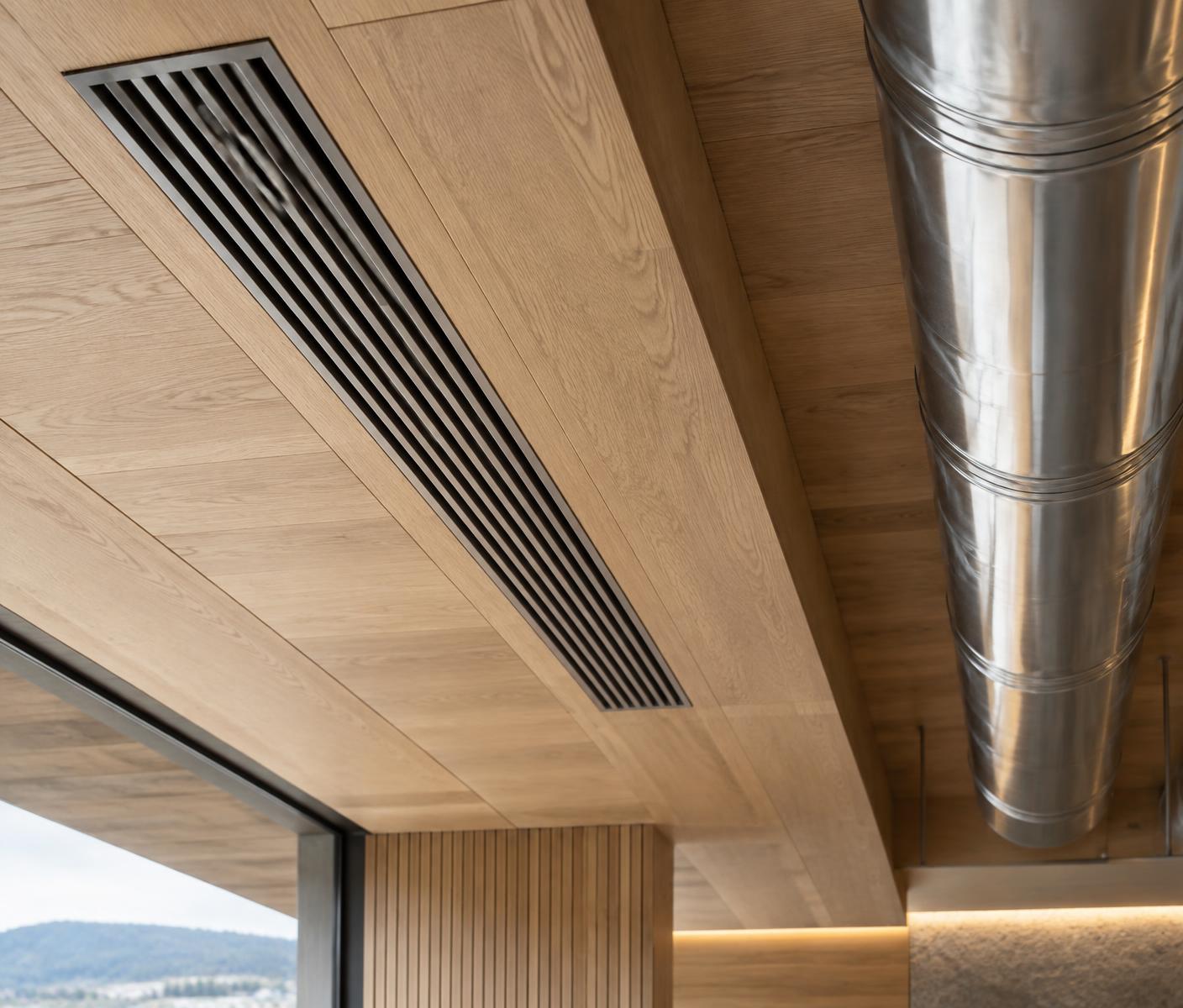
The ducts are just as important as the unit. Well-designed ductwork is sized to move the required air quietly, with smooth routes, minimal bends and sound attenuation where needed. Ducts need to be planned early, because they must pass through floors, walls and ceilings — often competing with structure, plumbing and lighting for space.
Poorly planned ductwork is one of the most common causes of disappointing MVHR systems: noise, low airflow and inefficiency usually trace back to decisions made (or not made) at design stage.
Commissioning
Once installed, an MVHR system must be commissioned. This means measuring airflows at each supply and extract valve and adjusting them to match the design, then recording the results. An uncommissioned system may appear to work while delivering too much air to some rooms and too little to others.
Ask to see the commissioning record. Building Regulations guidance in England (Approved Document F) sets out requirements for the testing and commissioning of ventilation systems in new dwellings.
Maintenance
MVHR is not a fit-and-forget system. Filters need cleaning or replacing at regular intervals, and the unit and ducts benefit from periodic inspection. Households should know where the unit is, how to change filters and what the controls do. Clear handover information makes a real difference.
Summer operation
In summer, heat recovery is not wanted. Many units have a summer bypass that allows incoming air to skip the heat exchanger, so cooler outdoor air — particularly at night — can be delivered without being warmed.
It is important to be clear about what this does and does not do. MVHR moves relatively small volumes of air. It is not air conditioning, and it cannot on its own prevent overheating in a house with large unshaded glazing. Summer comfort depends on the design of the building: orientation, shading, thermal mass and the ability to open windows. England's Approved Document O addresses overheating risk in new homes.
Common misconceptions
- "You can't open the windows." You can. MVHR provides background ventilation; opening windows is always an option, particularly in summer.
- "It's air conditioning." It is not. It ventilates and recovers heat; it does not provide significant cooling.
- "It will be noisy." A well-designed, well-commissioned system should be very quiet at normal rates. Noise usually indicates design or installation issues.
- "It uses a lot of electricity." Modern units use efficient fans, but consumption varies. Look at independently tested data for the specific unit.
Is MVHR right for every home?
Not automatically. MVHR is well suited to airtight new homes and deep retrofits where airtightness is being substantially improved. In a house where airtightness will remain modest, or where ductwork cannot be sensibly integrated, other approaches — such as continuous mechanical extract, or well-designed intermittent extract with trickle ventilators — may be more appropriate.
The right answer depends on the building, the airtightness achieved, the space available and the people who will live there. It should be a design decision, made early and made together with decisions about the fabric.
Questions to ask
- What airtightness level are we targeting, and is MVHR appropriate for it?
- Where will the unit go, and how will ducts be routed?
- Who designs the system, and who commissions it?
- How are filters changed, and how often?
- How will the house stay comfortable in summer?
At Home, you can see ventilation systems up close and talk to specialists who design and install them.
Last updated 25 September 2026
Key takeaways
What to remember.
- 01MVHR continuously extracts stale air from wet rooms and supplies fresh, filtered air to living spaces.
- 02A heat exchanger transfers warmth from outgoing to incoming air without mixing the two streams.
- 03It works best in airtight homes; in a leaky house much of the benefit is lost.
- 04Duct design, commissioning and filter maintenance determine real-world performance.
- 05MVHR is widely used in high-performance homes but is not automatically right for every project.
Explore at Home
Put the knowledge in context.
Relevant members at Home
Next step
Experience the ideas in person.
Explore products, systems and expertise together at Masson Mills.